
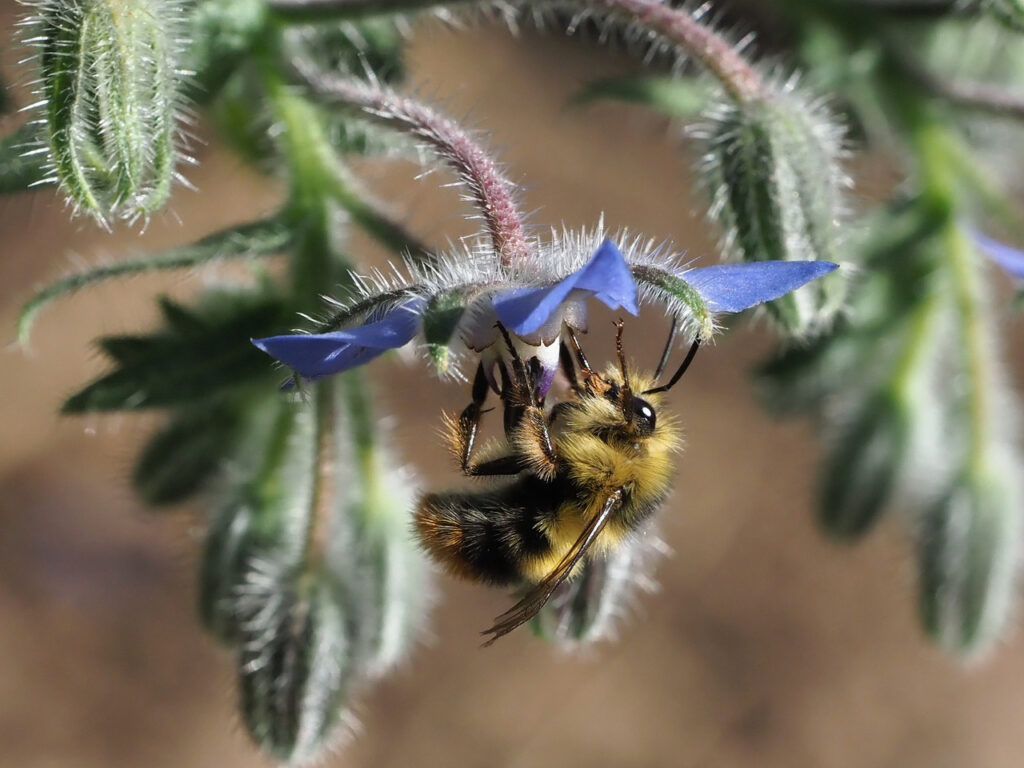
Have you ever wondered what species of bees are common in your garden and how many species there are? Or how the species vary through the summer? LINC is launching The Xwe’etay/Lasqueti Bumblebee Project to answer these questions and more about the diversity of our fuzzy pollinators.
This is a “citizen science” project: we invite the entire Lasqueti community to participate. Beginning in the spring of 2026, anyone who is interested in participating will photograph the bees in their garden (and elsewhere) as the season progresses. Photos will be uploaded to iNaturalist, a global database of biodiversity observations collected by citizen scientists. When a photo is upload to iNaturalist, it gives you a suggested ID that is then verified by experts from within the iNaturalist community. Each photo will be tagged with its location and other information (although you can choose to hide the location information from the public). Using these, we will be able to track the diversity of our bees through the summer and across the island, all the while contributing to the citizen science repository of biodiversity data. This will be publicly available to researchers and others interested in bees.
The Bees of Your Backyard – Webinar – with Dr. Elizabeth Elle
Have you ever paused to consider how much we owe to pollinators? About one in every three bites of food we eat depends on their work. Here in British Columbia, nearly 500 species of native bees do much of this vital pollination, supported by other flower visitors like flies, wasps, butterflies, and birds.
This engaging, photo-rich presentation introduces the diversity and natural history of bees and other pollinators you might see right in your own garden, and explores how to support them — from understanding nesting needs to planting for pollinators. You can watch the recording of the original webinar from February 4, 2026, below.
About the Speaker

Dr. Elizabeth Elle is a Professor of Biological Sciences at Simon Fraser University. For more than 25 years, she and her students have studied pollinators and pollination across British Columbia. An avid gardener, Elizabeth is passionate about translating ecological science into practical, pollinator-friendly gardening practices. Learn more at elizabethelleecology.ca.
The Bees of Your Backyard with Dr. Elizabeth Elle — Shorter Version For False Bay School
Have you ever paused to consider how much we owe to pollinators? About one in every three bites of food we eat depends on their work. Here in British Columbia, nearly 500 species of native bees do much of this vital pollination, supported by other flower visitors like flies, wasps, butterflies, and birds.
This is a shorter version of Dr. Elizabeth Elle’s longer webinar above made for the older students at False Bay School on Lasqueti Island. It focuses more on bee ecology and natural history, with less material on tips for gardeners.
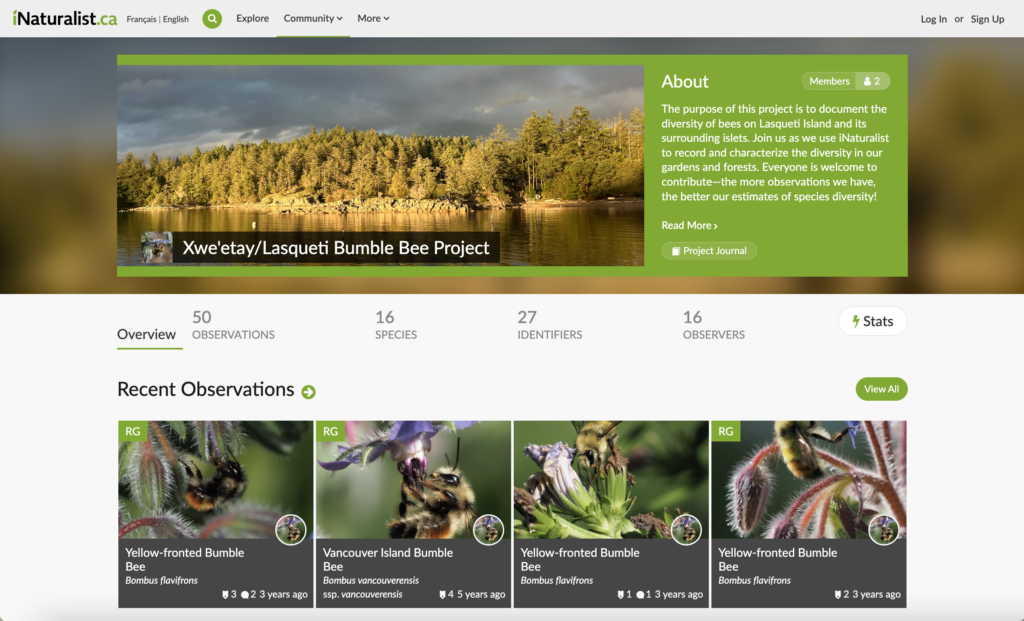
Xwe’etay Bumblebees on iNaturalist
There are 32 species of bumble bee (genus: Bombus) in BC, 13 of which occur in coastal BC (plus one introduced species). But we don’t know how many of these species occur on Lasqueti. In general, the map of bee occurrence is poor through the Strait of Georgia, although there are many records of observations on the mainland and Vancouver Island. We will help fill in this map.
Click the image below to visit our iNaturalist page.
Resources for Identifying Bumblebees
If you’d like to get started on learning how to identify bees, there are lots of resources available. Dr. Elizabeth Elle has created a short video for us on how to identify the Bumble Bees that are most likely to be seen on the South Coast of BC. As well, she has created some handy reference material on identification. The Native Bee Society of BC has some helpful bee identification guides available as free PDFs, both on bumble bees (https://www.bcnativebees.org/bee-id-post) and identifying native bees more generally to genus (https://www.bcnativebees.org/native-bee-genera-profiles). If you prefer an interactive web page instead, the Bumble Bee Watch (https://www.bumblebeewatch.org/field-guide/) has a helpful tool.
Other Resources
A practical, photo-based guide to identifying common bumble bees of British Columbia’s south coast. Created by Dr. Elizabeth Elle (SFU), it highlights key visual traits, seasonal tips, and notes on similar species.
A visual identification guide to the most common bumble bee species found along Coastal British Columbia, organized by colour patterns. Includes native and introduced species, notes on rarity and decline, and guidance on distinguishing male and female bees.
An accessible guide to the diverse bumble bees of the western U.S., featuring detailed species profiles, identification tools, habitat information, and conservation context.
A quick-reference, photo guide to common pollinators of BC’s South Coast.